
Owner FAQ ยท 44 Questions

Owensboro Metal Roof Coating Questions

Answers on rust, screws, laps, coating choices, weather, cost, permits, and the towns we cover around Owensboro.

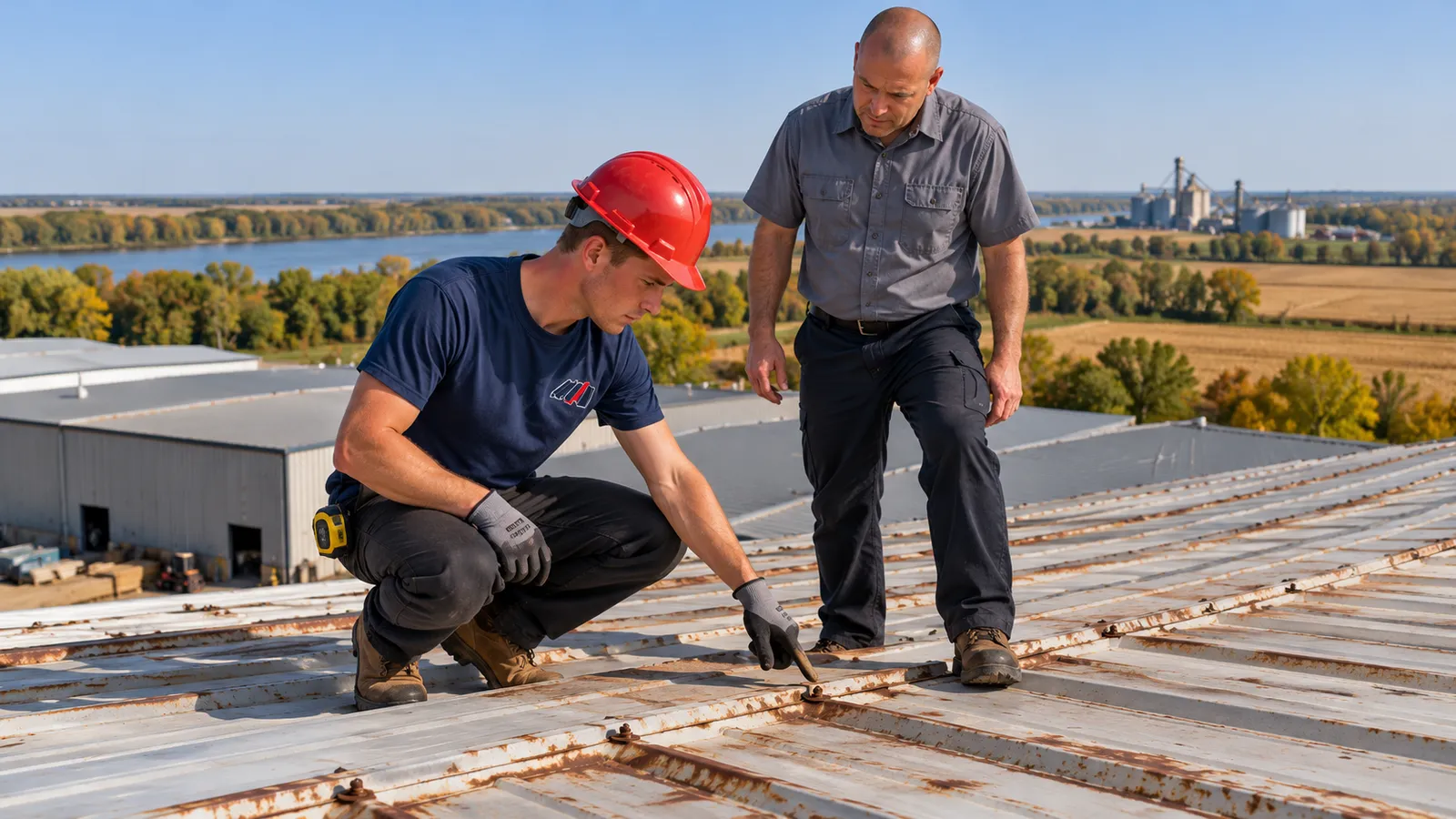
Roofer in a logo uniform inspecting a commercial metal roof in Owensboro

Metal Roof Coating Questions By Topic

Metal roof coating is a liquid-applied membrane that seals and protects an existing metal roof, covering fasteners, seams and panel laps in one continuous layer. Owensboro Metal Roof Coating coats commercial metal roofs and also offers silicone, acrylic, spray foam and shingle roof coating in Owensboro, Daviess County, Kentucky, and nearby towns.

Metal Roof Coating Basics

What does a coating do for a commercial metal roof?

A coating puts a continuous, flexible membrane over a metal roof so water has no open screw hole, panel lap or seam to find. On an exposed-fastener roof, that one layer covers hundreds of screw heads and washers that would otherwise each need separate attention.

The coating also handles three other jobs:

  • Stops new rust from forming on cleaned and primed steel
  • Reflects sunlight when a white or light color is chosen
  • Bridges small gaps at end laps, ridge caps and gutter seams with reinforcing fabric

A coating adds no structural strength. Panels and purlins still carry the load on their own, so badly corroded steel gets fixed first.

Which metal roofs are good candidates for coating?

Metal roofs with surface rust, loose fasteners and leaking laps, but with solid panels and framing, are the best candidates for coating. Warehouses, shops, farm buildings, churches with metal additions and strip retail with R-panel roofs all fit when the steel still holds a screw.

Good signs during a walk-through:

  • Rust limited to fastener heads, lap edges and scratches
  • Panels that feel firm underfoot with no thin or soft spots
  • Leaks that trace back to washers, skylight panels or end laps

Poor candidates show rust holes across the field, sagging purlins, or wet insulation trapped under the panels. Those areas get new panels or framing repair before any coating goes on.

How is a roof coating different from painting a metal roof?

Roof coating goes on much thicker than paint and is made to stretch with the steel as it heats and cools. Paint leaves a thin decorative film, while a coating system builds a waterproof membrane measured in mils of dry film thickness.

FeaturePaintRoof coating system
ThicknessThin filmMuch thicker, built in one or more coats
Seams and fastenersLeft as they areSealed with mastic and fabric first
Leak controlLittleMain purpose
MovementCracks over time at lapsElastomeric, flexes with the panels
PrepLight cleaningWashing, rust treatment, primer, seam work

Detail work at screws, laps and penetrations is what separates a roof coating from a cosmetic paint job.

What does a cool roof coating mean for a metal building?

A cool roof coating is a light-colored coating with high solar reflectance and high thermal emittance, so the roof surface stays cooler in direct sun. The U.S. Department of Energy cool roof guide describes both measures on a 0 to 1 scale, with higher numbers meaning a cooler roof.

On bare or dark steel over an uninsulated shop, a cooler surface means less heat radiating down onto workers, stock and equipment. The Cool Roof Rating Council directory lists rated roof products, so owners can check a coating's values before picking a color.

DOE also points out that dirt lowers reflectance over time, so aged ratings are the better numbers to compare.

Rust, Fasteners and Seams

Can a rusted metal roof be coated?

Yes, a rusted metal roof takes a coating well once the loose rust is scraped away and a rust-inhibiting primer covers the surface rust left behind. Coating straight over scale or flaking rust traps it, and the coating then peels from underneath.

Rust shows up in stages, and each gets a different fix:

  • Flash rust on clean steel: wash, dry and prime
  • Red rust at laps and screw heads: wire brush, then rust primer
  • Scale and pitting: grind or brush to firm metal, then prime heavily
  • Holes: cut out or patch with new metal before coating

Galvanized panels can also show white rust, a powdery zinc residue. It gets scrubbed off and primed with a product the coating maker approves, since coatings bond poorly to chalky white deposits.

What happens to the screws and washers before coating?

Every exposed fastener gets checked, tightened or replaced, and then sealed before the field coating goes on. Old rubber washers dry out, crack and let water run down the screw shank, which is the most common leak path on R-panel roofs.

Crews work through the fasteners in order:

  • Backed-out screws are driven tight or swapped for a larger-diameter screw where the hole has stripped
  • Missing screws are replaced, and empty holes are filled
  • Each screw head gets a dab or cap of compatible sealant
  • The full roof coating then covers the sealed heads

On a large warehouse roof, fastener work is a major share of the labor. It also explains why two roofs of the same size can need very different amounts of prep.

How are panel laps, end laps and ridge caps sealed?

Panel laps, end laps and ridge caps are sealed with brush-grade mastic or a reinforcing fabric bedded in base coat before the full coating goes on. These joints move as steel expands and contracts, so they need more material than the flat field of the panel.

End laps, where one panel overlaps the next down the slope, hold water and dirt and rust first. Open gaps at ridge caps and eave trim let wind-driven rain get behind the coating if they stay unsealed.

Crews typically use a three-course detail at these spots: a coat, a strip of polyester fabric, and a second coat over the fabric. Skylight panels, curbs and pipe boots get the same treatment where they meet the steel.

Does standing seam need different prep than exposed-fastener R-panel?

Standing seam and exposed-fastener roofs each get their own prep plan, built around where that panel type tends to leak. R-panel leaks start at screws and side laps, while standing seam leaks start at seams, clips, end laps and trim.

Prep itemExposed-fastener R-panelStanding seam
FastenersTighten, replace and seal every screwHidden clips, little fastener work
Side lapsSeal along each lapCheck raised seams for gaps
End lapsSeal and reinforceSeal and reinforce
MovementModeratePanels float more on clips
Coating focusScrew heads and lapsSeams, trim and penetrations

Standing seam also needs the coating maker's approval for floating panels, because the coating has to stretch with more thermal movement along each seam.

Choosing a Coating System

Is silicone or acrylic better over a metal roof?

Silicone holds up better where water sits in gutters and low end laps, while acrylic fits sloped metal roofs that drain fast and get recoated on a schedule. Most metal roofs shed water well, which keeps both options open.

FactorSiliconeAcrylicUrethane
Ponding resistanceStrongWeakGood
Sun exposureHolds up wellChalks graduallyAliphatic top coats hold color
Dirt pickupCollects dirtStays cleanerModerate
Recoating laterBonds best to more siliconeAccepts many coatingsAccepts several types
Foot trafficSoft, slick when wetModerateTough, impact resistant

Urethane is often used as a seam base coat or as a full system on roofs with heavy traffic. Primer choice comes from the coating maker's instructions for steel.

Can spray foam go over a metal roof instead of a coating alone?

Yes, spray foam can go over a metal roof when the building needs insulation as well as a watertight surface. Foam fills the panel ribs, buries every screw and lap, and then gets its own protective coating. A DOE building guide lists closed-cell foam near R-6 per inch.

FactorCoating onlySpray foam over metal
Insulation addedVery littleSet by foam thickness
Condensation under deckLittle changeReduced, since the steel stays warmer
Ridge caps and trimSealed in placeCovered by foam
Roof heightUnchangedRaised; curbs, gutters and trim adjusted
Rooftop workLightHeavier: spray rig, masking, overspray control

Foam makes the most sense on uninsulated shops where condensation drips from the underside of the panels.

Which coating details go on gutters, skylights and curbs?

Gutters, skylight curbs and HVAC curbs on metal roofs take the same coating as the field, plus extra reinforcement, because water collects and movement concentrates there. Built-in gutters are the hardest spot on many metal roofs, since water sits in them after every rain.

Common approaches:

  • Built-in gutters: clean to bare metal, prime, then a ponding-rated coating with fabric at every seam
  • Skylight panels: masked or replaced, with the coating stopped at a sealed edge around the curb
  • HVAC curbs: loose curb flashing re-fastened, then flashing seams reinforced with fabric
  • Pipe boots: cracked rubber boots replaced before coating around them

Translucent skylight panels stay uncoated so they keep letting daylight into the building.

Can an asphalt shingle roof on a commercial building be coated?

A commercial shingle roof can take a coating if the shingles lie flat and keep their granules and the coating maker has approved its product for shingles. Strip centers, offices and churches with steep shingle sections are the usual candidates.

Limits to check first:

  • Curled, cupped or brittle shingles, which a coating will not hold down
  • Heavy granule loss that shows the black mat underneath
  • Shingle manufacturer terms, which can treat a coating as a change to the roof
  • Attic and deck ventilation, since a coating changes how the shingles shed heat

When the shingles pass, the work covers cleaning, securing loose tabs, sealing flashing at walls and vents, and applying a shingle-rated coating. Shingles near the end of their life are better replaced.

Should the whole metal roof get the same coating color?

White across the whole roof gives the most reflectance, though some owners pick tan or light gray to match the building or hide dirt. Each color carries its own rated solar reflectance, and the Cool Roof Rating Council directory shows those values by product.

Mixed colors work too. Some owners keep ridge caps, rake trim and gutters in a darker shade for looks and coat the panel field white. Light gray hides rust streaks and dirt better than bright white on a roof that faces a busy road.

DOE notes that cool roofs can add some winter heating load, though in mixed climates summer gains usually come out ahead. Owensboro's hot, humid summers favor a lighter color on most commercial roofs.

Climate and Weather in the Owensboro Area

How does Owensboro weather wear on a coated metal roof?

Hot summer sun, humid nights, winter freeze-thaw and spring storms all work on a coated metal roof around Owensboro. The city falls under the National Weather Service office in Paducah, which publishes local climate data for stations across western Kentucky.

Each season leaves different marks:

  • Summer: chalking from sun and heat cycling that stretches coating at end laps
  • Winter: steel shrinking overnight, which works on seams and screw heads
  • Spring: wind-driven rain at ridge caps and trim, plus hail
  • Fall: leaves and grain dust packing into gutters and valleys

Cool nights on a metal roof also bring heavy dew, which sets the daily start time for coating work.

What does hail do to a coated metal roof?

Hail dents metal panels and can crack or chip the coating at the dent edges, leaving bare steel that rusts if left open. Small round dents in the panel flats are often cosmetic once checked, while dents at seams, end laps and ridge caps can open joints.

After a hail storm, look for:

  • Bright metal showing in the center of dents
  • Coating flakes collected in gutters and at downspouts
  • Cracked skylight panels and dented vent caps
  • Opened laps where a panel edge has bent

Spot priming and recoating exposed areas soon after the storm keeps rust from starting. Insurance claims stay between the owner and their carrier, and dated photos help that conversation.

What weather does a metal roof coating need to go on?

Coating goes on only when the steel is dry, above the dew point, and within the temperature range on the product data sheet. Each coating type has its own minimums, and acrylics are the most sensitive because they need warm, dry hours to cure before rain or dew.

Practical rules crews follow around Owensboro:

  • Start after morning dew burns off the panels
  • Stop early enough that the coat skins over before evening dampness
  • Skip days with rain in the forecast for acrylic jobs
  • Avoid gusty days that blow overspray toward cars and neighbors

Silicone tolerates cooler, damper conditions better than acrylic, which helps on spring and fall jobs. Panel surface temperature, checked with a surface thermometer, matters more than the air reading.

Question About Your Own Roof?

Every roof is different. Tell us what you see and we will answer it on the roof.

What To Have Ready
  • Roof type and age
  • Where leaks or drips show
  • Rust or loose screws you have seen
  • Town and building use
Get A Free Estimate

Prep, Application and Downtime

What are the steps to coat a metal roof?

Every metal roof coating job follows a fixed sequence that starts with an inspection and ends with a final coat at the specified thickness.

  • Inspect your roof: walk every panel and note rust, loose screws, open laps and damaged skylights
  • Wash: pressure wash dirt, chalk and grease, then let the steel dry
  • Repair: replace rusted-through panels and failed trim
  • Treat rust: brush and prime red rust and white rust
  • Fasten and seal: tighten or replace screws, then seal heads and laps
  • Reinforce: fabric at end laps, ridge caps, curbs and gutters
  • Coat: base and top coats, or one heavy coat, to the mil thickness on the product sheet

Wet-film gauge readings taken during spraying confirm each section gets enough material.

Can a business keep running while the roof is coated?

Most businesses keep running during a metal roof coating because nearly all the work happens on top of the panels. Inside, people hear pressure washers and foot traffic, and odor varies with the products chosen.

Planning points:

  • Rooftop intakes near the active area are shut down or covered during spraying
  • Cars near the eaves are moved or covered against overspray
  • Dock doors under the work zone are scheduled around
  • Leaks found during washing get temporary sealant before the crew leaves

Water-based acrylics carry little odor, while solvent-borne primers and some silicones have more. Facility managers can ask for the safety data sheet for each product before work starts.

How long does it take to coat a metal roof?

Coating time comes down to roof size, the amount of fastener and rust work, and the weather window. A small shop roof can move from wash to final coat in a few working days, while a large warehouse runs longer.

Time drivers seen on the roof:

  • Screw count and how many need replacing
  • Rust scale that has to be ground or brushed
  • Linear feet of end laps, ridge caps and gutters that need fabric
  • Skylight panels and curbs to detail
  • Cure time between coats, plus rain delays

Big roofs in the Owensboro area are often coated in sections so each finished area is sealed by the end of the day.

Cost and Value

What drives the cost of coating a metal roof?

Roof size, rust level, fastener count and the coating system chosen drive the cost of a metal roof coating more than anything else. Two roofs with the same square footage can differ widely because prep labor changes with condition.

Main cost drivers:

  • Rust treatment: light flash rust versus scale that needs grinding
  • Fasteners: sealing heads only versus replacing hundreds of screws
  • Panel repair: rusted-through sheets or broken skylight panels
  • Coating type and thickness: silicone, acrylic, urethane or a foam system
  • Detail work: gutters, ridge caps, curbs and penetrations
  • Access: roof height, lift needs and edge safety

An on-roof inspection with measurements gives the only reliable basis for cost.

Should I coat, restore, re-panel or replace my metal roof?

Panel and framing condition decides the choice: coat solid steel, restore when rust and leaks need heavier repair first, re-panel when sections are rusted through, and replace when framing or most panels have failed.

OptionWhat it involvesFits when
CoatWash, prime, seal fasteners and laps, coatSurface rust, leaking screws, solid panels
RestoreCoating plus heavy rust work, screw replacement, trim repairWidespread red rust and open laps
Re-panelReplace damaged sheets, then coat the whole roofRust holes in some areas
Spray foam recoverFoam over the panels, then coatingLeaks plus a lack of insulation
ReplaceTear off panels and trim, check framingFailed purlins or most panels rusted through

A walk-through that checks for soft spots, rust holes and sag between purlins usually settles which row a roof falls into.

Taxes, Permits and Utilities

Can a metal roof coating qualify for Section 179?

Roof work on an existing nonresidential building can qualify as Section 179 property under IRS Publication 946. Roofs are listed as qualified real property when the improvement is placed in service after the building itself.

Key figures for tax years beginning in 2026:

  • Deduction limit of $2,560,000
  • Phase-out once qualifying purchases pass $4,090,000
  • Residential rental property excluded

Whether a coating counts as a capital improvement or a repair is a tax question, and the answer changes how it is deducted. A CPA should review the scope, invoices and building use. Keep dated photos of the panels, fasteners and rust from before the work as part of the records.

Does a metal roof coating in Owensboro need an OMPC permit?

The Owensboro Metropolitan Planning Commission (OMPC) handles building permits, plan review and inspections for Owensboro and Daviess County outside the City of Whitesville, according to the Greater Owensboro EDC permitting guide. Ask OMPC early whether a coating project needs a permit.

Scope settles most permit questions. A coating over existing panels changes little, while these items draw more review:

  • Replacing panels or decking across large areas
  • Relocating rooftop units or adding curbs
  • Changing gutters, downspouts or roof drains
  • Adding spray foam that raises the roof edge

Moving a disconnect at an HVAC unit can also bring in an electrical permit, so check before ordering material.

Which offices handle permits for roof coating jobs outside Daviess County?

Outside Daviess County, commercial building inspection runs through a county inspector or the Kentucky state building inspector, based on each county's contact sheet with the Kentucky Department of Housing, Buildings and Construction (HBC).

TownCountyBuilding inspection on the HBC listing
OwensboroDaviessOMPC, local
Central CityMuhlenbergCounty local building inspector
Beaver DamOhioState building inspector
HartfordOhioState building inspector
LewisportHancockState building inspector; local electrical through county or city
HawesvilleHancockState building inspector; local electrical through county or city
LivermoreMcLeanCounty local building inspector
PhilpotDaviessOMPC, local
MaceoDaviessOMPC, local
UticaDaviessOMPC, local
WhitesvilleDaviessOutside OMPC building permits; confirm with City Hall
CalhounMcLeanCounty local building inspector

City halls can set extra rules, so call the clerk in each town as well. Work that moves rooftop units or replaces roof panels is what most often draws an inspector's interest.

Questions by Town

How should grain-handling and farm metal buildings around Owensboro be prepped for coating?

Grain-handling, feed and equipment buildings around Owensboro need a heavy wash and a gutter cleanout before coating, because grain dust and chaff block adhesion and hold moisture against the steel. On Daviess County farm buildings, red rust tends to start along eave trim and gutters where dust and water collect.

Prep for these buildings adds:

  • Washing dust out of panel ribs and ridge vents
  • Clearing bird nests from eave closures and sealing the gaps
  • Spot-sealing bird pecks and screw holes near spill areas
  • Timing work outside harvest so trucks and dust stay off the job

Grain bin roofs are a separate case. Their vents, ladders and roof rings follow the bin maker's rules, so check with the bin manufacturer before coating one.

Which utility should an Owensboro business call about a reflective roof coating?

Owensboro businesses buy power from either Owensboro Municipal Utilities, the city's public power utility, or Kenergy, a member cooperative that serves Daviess County. The name on the electric bill tells you which one.

Questions to put to that utility before coating:

  • Does a cool roof coating count toward any current commercial program?
  • What records are needed, such as the product's rated reflectance?
  • Is a commercial energy assessment offered?

Never assume a rebate. Keep the Cool Roof Rating Council listing for the chosen product, plus before-and-after photos of the panels and ridge caps, to make any later conversation easier.

Who handles the permit question for a metal roof coating in Central City?

Central City sits in Muhlenberg County, which lists a local building inspector with the Kentucky HBC, so a Central City coating project starts with that county inspector. Owensboro's planning commission has no role in Muhlenberg County.

Coatings over existing panels rarely change structure, but the inspector is the right call when a job involves:

  • Replacing rusted-through panels or purlins
  • Raising curbs for rooftop units
  • Changing downspouts or gutter outlets near sidewalks

Central City's city hall is the second call for any local rules. Kenergy serves Muhlenberg County, so energy questions for a Central City shop go to the co-op's member services line.

Can a shingle-roofed church or office in Central City get a roof coating?

A shingle-roofed church, office or storefront in Central City can be coated only if the shingles lie flat, keep their granules, and the coating maker approves the system. Shingle coating extends a roof in decent shape; curling and brittle tabs stay as they are underneath.

A Central City walk-through checks:

  • Granule loss in gutters and at downspout splash areas
  • Lifted tabs along rakes and ridges
  • Step flashing at walls and around chimneys or bell towers
  • Valleys where water and debris run heaviest

Many church and office buildings pair a low-slope metal or membrane section with a steeper shingle section. One job can cover both, each with its own coating type.

Does a Beaver Dam metal roof coating go through a state or local inspector?

Ohio County's contact sheet with the Kentucky HBC names the state building inspector and no local one, so Beaver Dam coating projects that need review go to the state office. Beaver Dam's city hall can add rules inside city limits, so it gets a call too.

A plain coating over existing R-panel stays light on review. These changes draw more attention:

  • Adding spray foam that raises the eave and gutter line
  • Cutting new openings for exhaust fans or skylights
  • Replacing structural framing under rusted panels

Raise them with the inspector before scheduling so the coating crew and any framing work line up. Beaver Dam businesses get power from Kenergy or Meade County RECC, since both co-ops list Ohio County.

Can metal canopies and awnings on Beaver Dam storefronts be coated with the main roof?

Metal canopies, awnings and mansard fascia on Beaver Dam storefronts can be coated in the same job as the main roof, using the same rust prep and primer. These pieces often rust first because they sit low, catch splash and drain onto sidewalks.

Canopy details to plan:

  • Gutters and downspouts that empty onto walkways, cleaned and sealed at every joint
  • Lights and sign brackets fastened through the panels, sealed around each penetration
  • Wall flashing where the canopy meets the storefront, re-secured before coating
  • Overspray protection for glass, signs and parked cars at the curb

Walkway closures during the work keep customers clear of pressure washing and coating drips.

How are metal roofs behind parapet walls in Hartford coated?

Older masonry buildings in Hartford, the Ohio County seat, with low-slope metal or patched roofs behind parapet walls need the roof-to-wall joint sealed before any field coating. That joint, with its counterflashing and through-wall scuppers, is where most leaks start.

Prep at the parapet:

  • Clear each through-wall scupper and seal its metal liner
  • Re-secure loose counterflashing and reglet edges
  • Repoint open mortar at the coping so water stays out of the wall
  • Extend fabric-reinforced coating up the parapet face

Water entering through cracked coping stones travels behind any new roof coating, so masonry repair belongs in the same plan.

Can one project cover a Hartford building with both metal and built-up roof sections?

A Hartford building with a metal shop addition tied into an older built-up roof can be coated in one project, with a planned transition at the joint between the two. Each surface gets its own prep and coating approach.

SectionPrepCoating approach
Metal panelsRust primer, screw sealing, lap fabricSilicone or acrylic system for metal
Built-up roofGravel removal, moisture survey, blister repairPrimer and coating rated for asphalt
TransitionFlashing where panels meet the low roofFabric reinforced, extra thickness

Wet felts found under the built-up section get cut out before coating. Ohio County lists the state building inspector for permit questions on this kind of work.

What should industrial metal roofs near the Lewisport rolling mill expect before coating?

Industrial metal roofs in Lewisport need adhesion testing before coating, since exhaust fallout and process residue can film over the panels. A Kentucky state release describes the town's aluminum rolling mill, opened in 1966, which makes auto body sheet.

Steps on industrial roofs:

  • Test patches near exhaust fans and vents, pulled after cure
  • Degreasing and pressure washing of stained panels
  • Rust primer wherever fallout has etched the galvanizing
  • Phased work so intakes shut down one zone at a time

Plant rules also shape the job, from site badging to hot-work permits near exhaust stacks and vent hoods.

Does a Lewisport roof coating job go to a state building inspector?

Hancock County's HBC contact sheet lists the state building inspector and no local building inspector, so Lewisport building questions on a coating job go to the state office. Lewisport's city hall confirms any added local rules.

Jobs that stay on the surface, such as washing, priming, sealing screws and coating the panels, change little about the building. Replacing purlins, adding skylight openings or putting spray foam over the panels is a bigger scope to raise early.

Hancock County businesses get power from Kenergy or Meade County RECC, since both co-ops list the county. Check the bill before asking about any program tied to reflective roofing.

Who signs off on electrical work for rooftop units during a Hawesville roof coating?

Electrical inspection in Hancock County runs through the county judge-executive's office or the city office where the work sits, according to the county's HBC contact sheet. As the county seat, Hawesville has both offices in town.

Coating jobs touch electrical work more often than owners expect:

  • Raising a condensing unit onto a taller curb so coating can run underneath
  • Moving a disconnect that blocks a seam or end lap
  • Re-routing conduit lying loose across the panels
  • Resealing a rooftop junction box after prep

Ask which office covers the address before the electrician and coating crew set dates.

How can a large Hawesville plant roof stay protected during a multi-day coating job?

Large Hawesville plant roofs stay protected during a multi-day job by finishing each section through primer and base coat before the crew opens the next one. Washed, unprimed steel left overnight can flash rust, and open laps let storm water in.

End-of-day checks on these roofs:

  • Every washed panel primed or covered before the crew leaves
  • Fabric laps finished to a clean edge so the next day's coat ties in
  • Gutters and roof drains cleared of wash debris
  • Masking on intakes and skylights inspected after wind

A storm forecast moves the plan, so the crew coats smaller areas on unsettled days.

Where does a Livermore business check permit rules before coating a metal roof?

McLean County lists a local building inspector with the Kentucky HBC, so a Livermore coating project starts with that county office. Livermore's city hall is the next call for any city rules.

Questions to bring to the inspector:

  • Do replaced panels or new purlins need review?
  • Can rooftop units be raised on taller curbs under the current permit?
  • Are gutter and downspout changes near the street covered?

Kenergy serves McLean County, so a Livermore business asks Kenergy member services about any energy program connected to a reflective coating.

How is white rust handled on older galvanized buildings around Livermore?

White rust on older galvanized shops and equipment buildings around Livermore is scrubbed off and primed before coating, because the powdery zinc residue keeps coating from gripping the steel. It forms where water sits on galvanized panels, often at end laps, along the bottom of panel ribs, and under bird droppings.

Treatment steps:

  • Scrub with a stiff brush and a cleaner approved by the coating maker
  • Rinse well and let the panels dry fully
  • Test adhesion on a small patch
  • Prime with a product rated for galvanized steel

Red rust spots showing through the white mean the zinc layer is gone there, so those spots get rust primer as well.

Does a Philpot metal shop go through OMPC for roof coating questions?

Philpot is an unincorporated Daviess County community, and OMPC handles building permits and inspections for the county outside the City of Whitesville, so Philpot coating questions go to OMPC. No city hall sits between the owner and that office.

Bring OMPC a short packet so staff can judge the scope:

  • Photos of each slope showing rust at screw rows and end laps
  • A sketch marking skylight panels, ridge vents and gutters
  • Notes on any purlin or panel replacement
  • Product data sheets for the primer and coating

A coating over solid panels changes little about the building. Framing repair or new roof openings are the parts worth flagging at the first conversation.

Who handles building permits for a metal roof coating in Whitesville?

Whitesville belongs to the OMPC planning area for zoning and subdivisions through a joint agreement with Owensboro and Daviess County, yet the OMPC building permit service covers the county outside the City of Whitesville. Building questions for a Whitesville roof start at City Hall.

Ask the city which office inspects commercial roof work, and whether panel replacement, taller curbs, or spray foam change that answer.

On shops and storefront buildings in town, plan the scope around:

  • Metal coping along front parapets
  • Box gutters tucked behind the parapet wall
  • Rooftop units sitting over the sales floor
  • Roof hatches and ladders the crew will use

Settling the permit route first keeps a short dry-weather window from slipping past.

Which utility should a Maceo business ask about a spray foam roof?

Kenergy, the Big Rivers member cooperative serving Daviess County, is the likely power provider for a Maceo business, though the name on the electric bill settles it. Ask that utility before choosing between coating alone and foam plus coating.

Useful questions:

  • Does any commercial program count added roof insulation?
  • What foam thickness and R-value records does it want?
  • Is an energy assessment offered for metal buildings?

Foam buries exposed screws and side laps and raises the eave line, so gutters and drip edge get reset during the job. Get any program answer in writing before planning around it. Permit questions for unincorporated Maceo go to OMPC.

How does a Utica owner pick coating days with the Paducah weather office?

Utica falls in the National Weather Service Paducah forecast area with the rest of Daviess County, so that office's hourly dew point, rain and wind forecasts set the coating days. Crews compare those hours with the coating's data sheet before washing a section of panels.

On an open rural lot, watch for:

  • Dew point close to panel temperature at sunrise
  • Gusts that carry overspray off the eave
  • Afternoon storm chances on acrylic days
  • Overnight lows under the product minimum

Utica is unincorporated, so permit questions on the job go to OMPC instead of a city office.

What should a Calhoun business know about coating a metal roof near the Green River?

Calhoun, the McLean County seat on the north bank of the Green River, relies on the McLean County local building inspector listed with the Kentucky HBC for permit questions. Kenergy supplies power across McLean County.

Riverside mornings can keep steel panels damp longer, which pushes start times later and stretches the dry window acrylic coats need. Silicone handles those damp starts better.

Before coating, check:

  • Rust streaks under screw rows on shaded slopes
  • Mud and debris packed into gutters and outlets
  • Ponding at low end laps
  • Torn closures under ridge caps

Check with Calhoun City Hall too, in case the city adds its own rules for work inside its limits.

Getting Started

What information speeds up a metal roof inspection?

Roof age, panel type and a list of known leak spots speed up a metal roof inspection more than anything else. With those in hand, Owensboro Metal Roof Coating can go straight to the problem areas.

Useful items to have ready:

  • Panel type, such as exposed-fastener R-panel or standing seam
  • Past coatings, especially silicone, since it limits what bonds later
  • Interior stains, drips and the bays where they show up
  • Access points such as a roof hatch, fixed ladder or lift area
  • Equipment schedules showing when rooftop units can shut down

Photos of ceiling stains and wet insulation help match each leak to a fastener row, lap or skylight panel on the roof.

Get A Metal Roof Coating Estimate

Tell us about your building and roof. We follow up to inspect it in person.

Call Us (270) 236-5562