If Your Roof
Leaks at screws, but the panels feel firm underfoot
Dried washers let water run down the screw shank. Sealing every fastener and coating the field stops that path.
Start WithMetal Roof Coating

We coat commercial metal roofs in Owensboro and nearby towns: screws tightened and sealed, rusted laps primed, then a full coat over the panels.
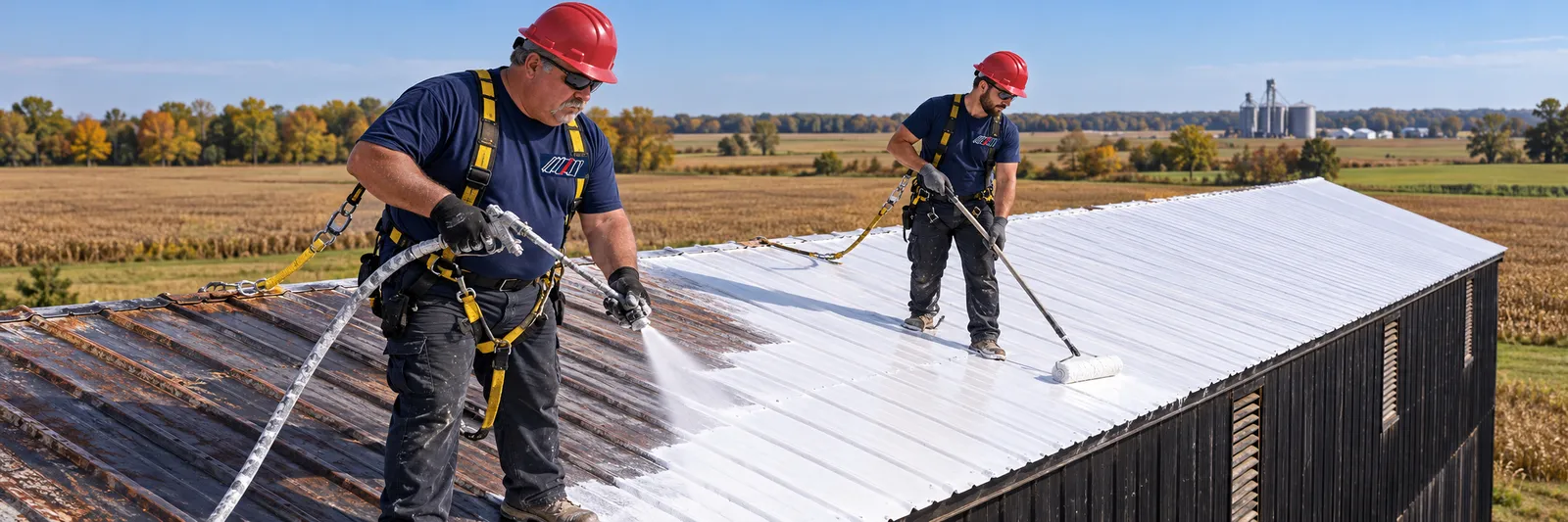
Owensboro metal roof coating is our main work, and we install four more systems. Each row shows where that system fits on a commercial building.
| System | Best Substrate | Ponding Tolerance | Typical Use | Recoat Path |
|---|---|---|---|---|
| Metal Roof Coating | Exposed-fastener R-panel and standing seam steel | Fine on panels that shed water; gutters get extra build | Warehouses, shops, farm buildings, church additions | Matches the topcoat chosen, silicone or acrylic |
| Silicone Roof Coating | Metal, low-slope membranes, foam | Strong; holds up where water sits in gutters and low laps | Built-in gutters, low end laps, flat sections | Silicone over silicone only |
| Acrylic Roof Coating | Sloped metal and foam that drain fast | Weak; needs a roof that sheds water | Pitched steel shops and white reflective topcoats | Accepts many coatings later |
| Spray Foam Roofing | Metal panels, concrete, and old built-up roofs | Foam can be built up to help water reach the drains | Uninsulated shops with condensation drips | New topcoat over the foam when it wears |
| Shingle Roof Coating | Flat-lying asphalt shingles that keep their granules | Steep slopes only; water never sits | Strip centers, offices, and churches | Shingle-rated coating per the maker's terms |
Not sure which row your building falls in? Compare all five commercial roof systems or start with the free ballpark estimate.
Panel and framing condition decides the answer. Find the line that sounds like your roof.
Dried washers let water run down the screw shank. Sealing every fastener and coating the field stops that path.
Gutters and low end laps need a coating rated for ponding, with fabric at every seam.
That is condensation on cold steel, so insulation solves more than a coat would.
Coating adds no strength, so failed steel and framing come out before anything goes on.
A few details about the building get your estimate started faster and point us to the right part of the roof.
Five steps, in this order, on every metal roof we coat in Owensboro.
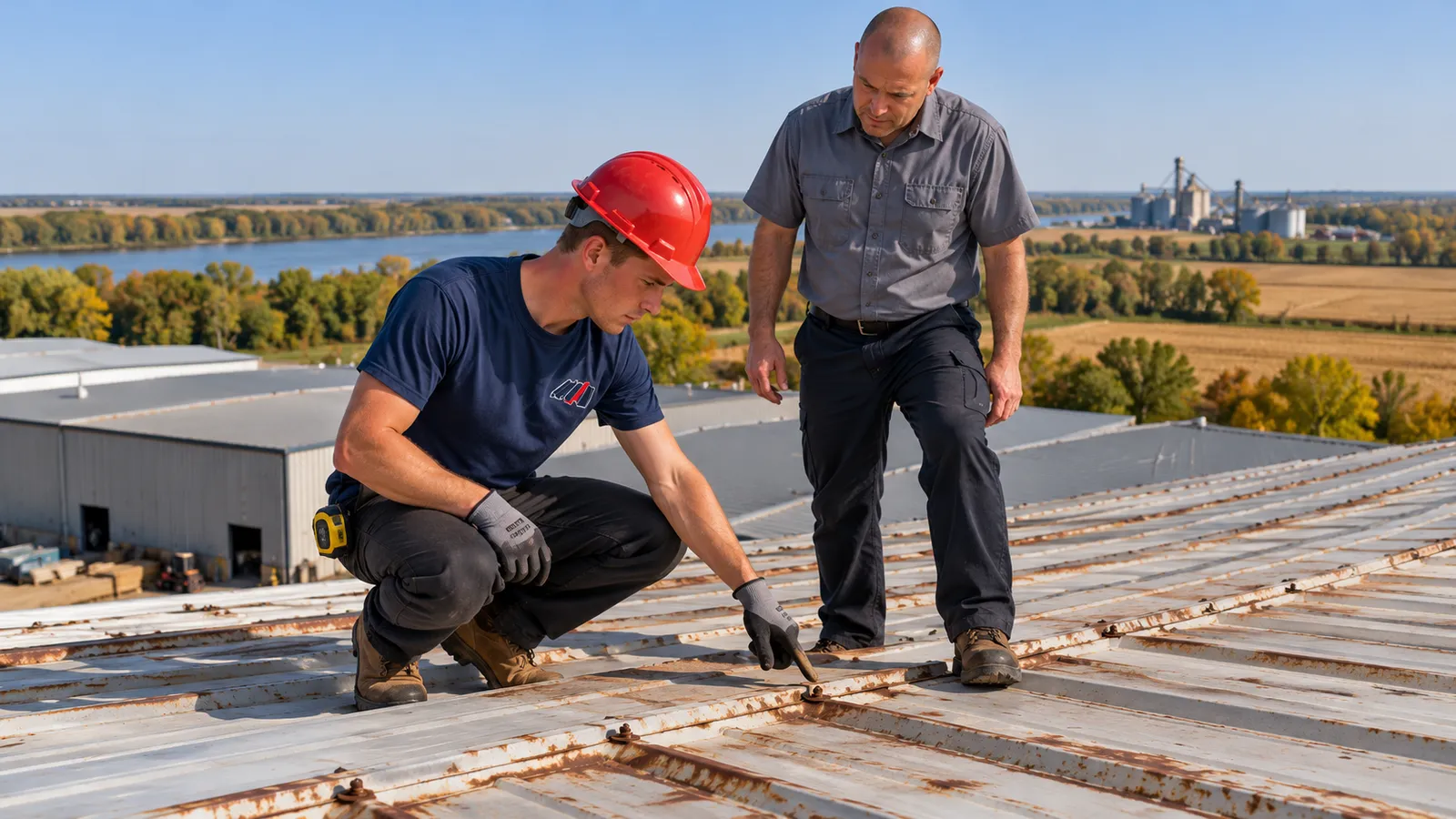
Walking every panel, we mark loose screws, open end laps, rust stages, soft spots, and cracked skylight panels on a roof sketch.
Pressure washing strips dirt, chalk, and grease. Rusted-through sheets and failed trim are replaced before prep moves on.
Loose scale is brushed or ground to firm steel, then a rust-inhibiting primer covers red and white rust.
Backed-out screws get tightened or upsized, each head gets sealant, and fabric goes over end laps, ridge caps, and curbs.
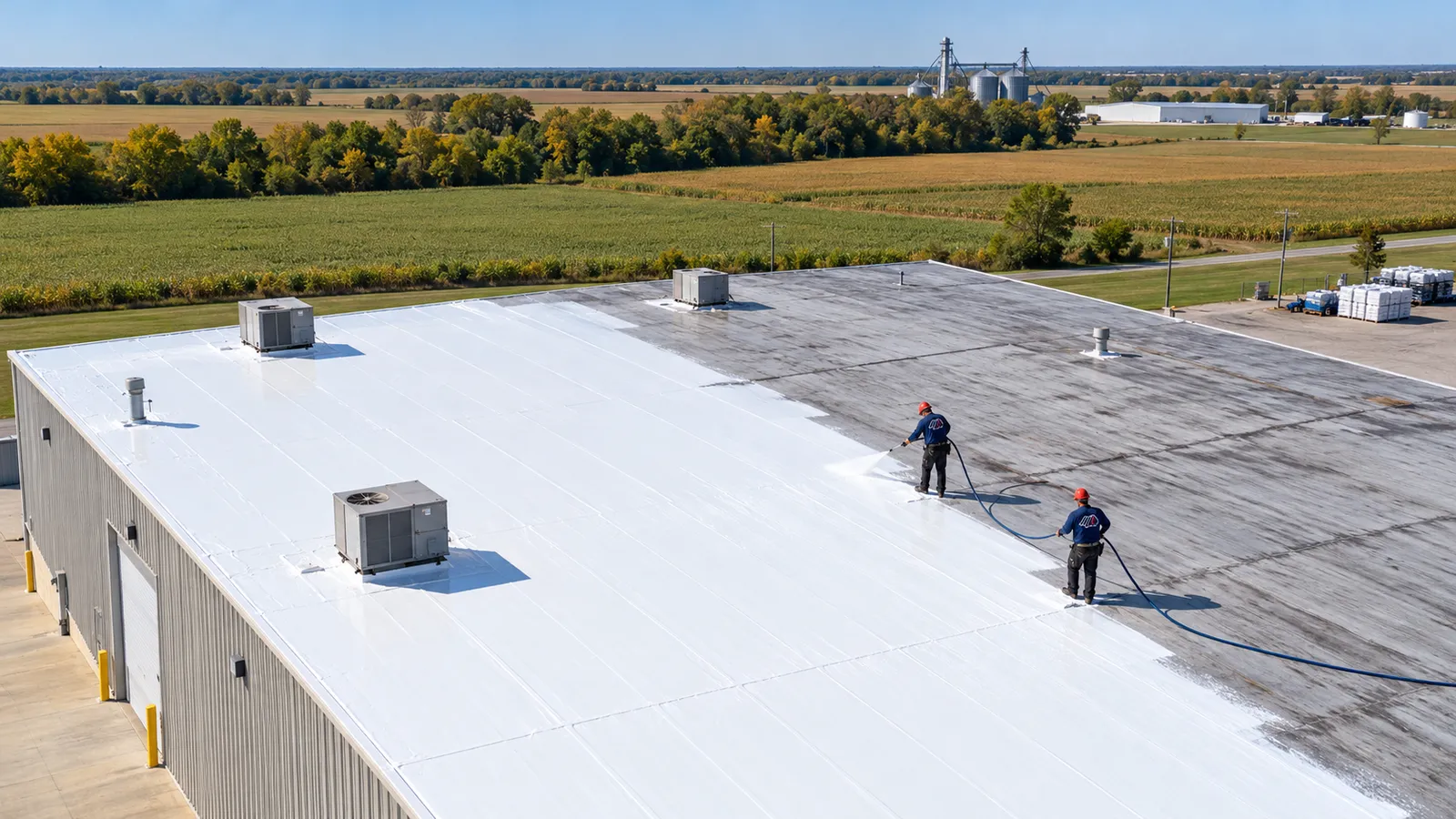
Base and top coats go on to the mil thickness on the product sheet, checked with a wet-film gauge as we spray.
Water finds the same five zones on most commercial metal buildings around Owensboro. These are the spots we check before quoting a coating.
Rake trim and eave closures loosen in wind, and grain dust packs behind them. Red rust usually starts along this edge first.
Side laps and end laps hold dirt and water. On R-panel, cracked washers in every screw row add hundreds of small entry points.
Built-in gutters stay wet after rain, and leaves plug the outlets. Seams there rust through faster than anywhere else.
HVAC curbs, exhaust fans, pipe boots, and skylight panels all break the steel. Loose curb flashing and cracked boots leak at the joint.
Soft panels, sagging purlins, or wet insulation under the steel mean repair work before coating. A coat adds no strength.
When panels and purlins are solid, coating keeps the existing steel working. Here is how the two jobs compare on the roof.
| Roof Detail | Coating The Roof | Replacing The Roof |
|---|---|---|
| Exposed Screws | Each head is sealed, then buried under the coating | New panels bring hundreds of new fasteners and washers |
| Rusted Laps | Primed and covered with fabric and coating | Removed along with the old panels |
| Daily Operations | Work happens on top of the panels while the building runs | Panels come off, so the interior is exposed in stages |
| Heat On The Roof | A white or light topcoat reflects sunlight off the steel | Depends on the new panel finish |
| Later Upkeep | A worn coating can be cleaned and recoated | Fasteners need checking again as washers age |
Not sure your building falls in our area? Call us or send us a message. We coat commercial roofs in Owensboro and the eleven towns below.
Farm shops and equipment sheds along US 60 often need rust primer at the eaves before coating.
East Daviess metal shops here go through OMPC, and screw-row rust is the usual starting point.
Rural shops south on US 431 get coating days picked from dew point and wind forecasts.
Storefront roofs behind parapets drain into box gutters, and building permits start at City Hall.
Industrial panels near the rolling mill get adhesion test patches before any full coat goes on.
Damp riverside mornings keep panels wet longer, so silicone often fits the shorter dry window.
Older galvanized shops show powdery white rust that gets scrubbed and primed first.
Plant roofs are coated section by section, with rooftop electrical sorted before the crew starts.
Masonry buildings with parapet walls need the roof-to-wall joint sealed before field coating.
Canopies and awnings on storefronts can be coated in the same job as the main roof.
Churches and offices with steep shingle sections and low metal roofs can be coated together.
Short answers to what owners ask most. The full list is on our metal roof coating FAQ.
Prep labor moves the price more than square footage. Light flash rust costs less to treat than scale that needs grinding, and sealing screw heads costs less than replacing hundreds of screws. Coating type and thickness, gutters and curbs, and lift access add to it. Measurements taken on the roof are the only reliable basis.
Condition changes the labor. One warehouse might need only a wash and sealed screw heads, while the building next door needs rusted sheets replaced, every washer swapped, and fabric along each end lap. Coating material is a smaller share of the job than that prep work.
Usually, yes. Nearly all of the work happens on top of the panels, so people inside mostly hear pressure washers and footsteps. Rooftop intakes near the active area are shut down or covered while we spray, cars near the eaves are moved, and dock doors under the work zone are scheduled around.
Units near the active section are shut off and their intakes covered so overspray and odor stay outside. Loose curb flashing is re-fastened first, and the curb seams get fabric. Your facility manager tells us which hours each unit can be down, and we plan the sections around that.
It lays one continuous, flexible membrane over the panels, so water has no open screw hole, lap, or seam to find. It also stops new rust on primed steel, reflects sun when a light color is chosen, and bridges small gaps at laps and ridge caps with fabric. It adds no structural strength.
Only when the drips are leaks. Water that shows up after rain at screw rows or laps is a leak, and coating stops it. Drips on cool, dry mornings come from condensation on cold steel, and spray foam insulation over the panels is the fix for that.
Tell us about the building and its roof. We will follow up to look at the panels, screws, and laps in person.